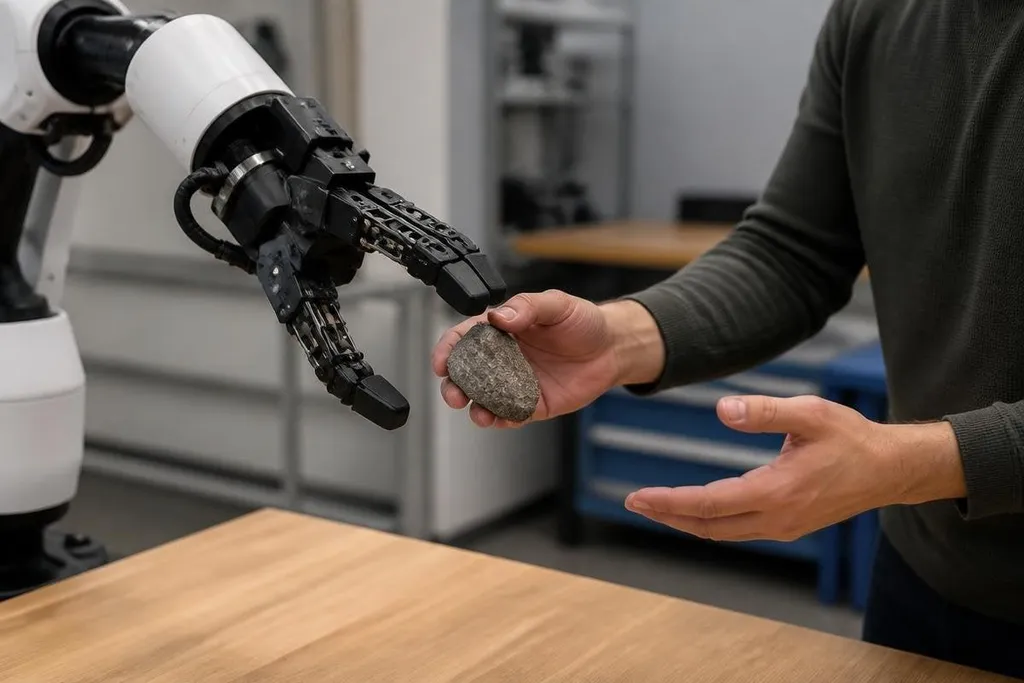
A robot hand can close around an object in a planned demo. Human hands do far more: they feel slip, adjust pressure, and change grip without stopping to calculate each move. The question for robotics teams is how to give machines that same loop of touch, control, and motion.
- Human hands adjust force while moving.
- Robot hands need tactile sensors, careful control, and useful training data.
- General hand skill remains unproven outside set tasks.
A grip is only the first step
With position control, a robot can hold an object. The system tells each joint where to move, then checks whether the hand reached that position. That works well when the object, angle, and task stay close to the setup used in testing.
Human hands work with less certainty. Fingers press into an object, skin feels changes in pressure, and the nervous system reacts before the object slips away. A robot hand needs a similar stream of data from sensors in its fingertips, joints, or palm.
That data has to arrive fast enough to guide movement. A sensor that reports contact after the object has fallen is not much help. The hand also has to tell the difference between a soft squeeze, a hard push, and a sideways force that could start a slip.
Touch turns motion into control
Tactile sensing measures contact at the hand. Cameras can show where an object is, but they may not show whether a fingertip has enough force to hold it. Force-torque sensors add another layer by measuring loads at the wrist or tool mount.
The control system then changes the motor commands. It may reduce pressure on a thin object, shift one finger, or close another finger around a moving edge. Each action needs a short feedback loop, with the sensor reading followed by a new motor command.
This is why human-like hand shape alone won't settle the question. A hand with five fingers and many joints can still fail if its sensors are slow, its motors lack fine control, or its software cannot link touch to the task.
Hand research crosses lab prototypes and factory automation, so each claim needs a named robot and a recorded task behind it. Robot24.com's hand robotics coverage gives industry readers that reference before the next section looks at where robot hands still struggle.
Where robot hands still struggle
Human hands handle objects with unknown weight, shape, texture, and stiffness. A robot hand can learn a repeatable routine, yet a small change in any of those properties can alter the force needed to hold the object.
The hardware has limits too. Small motors can give precise motion but may lack the force needed for heavy tools. Stronger motors add weight, heat, and power demand at the fingers or wrist. A hand that works well on a bench may become hard to control when mounted on a moving arm.
Software adds another problem. Training a hand to pick one item is easier than teaching it to select a safe grip for an object it has never seen. The system needs examples that cover contact points, slips, collisions, and failed attempts. Without that range, it may repeat a narrow routine rather than build a general skill.
Safety also changes the design. A human finger can yield when it meets a person or a fragile object. A robot needs force limits, collision detection, and a stop system that react before the contact causes harm.
What would count as human-level skill?
A useful test would need more than a clean video. It should give the robot unfamiliar objects, varied surfaces, changing loads, and tasks that require several grips in sequence. The test should also report failure rates, recovery time, damage to objects, and how much human control the robot received.
That last point matters. Teleoperation can make a robot hand look skilled because a person is choosing the grip and correcting errors from a remote console. A fair test would separate the hand's physical ability from the operator's decisions.
I’d treat claims of human-level dexterity as unproven until a robot hand handles a broad set of tasks without task-specific setup or constant human correction.
A buying and testing checklist
Before you judge a robot hand for factory work or research, check these points:
- Contact data: find out where tactile or force sensors sit and how often they report readings.
- Object range: ask for results on new shapes, surfaces, weights, and materials.
- Recovery: check what happens after a slip, blocked joint, lost camera view, or failed grasp.
- Human input: separate fully autonomous runs from teleoperated or pre-programmed demos.
- Service needs: check finger replacement, motor access, cable routing, and cleaning limits.
A robot hand may match a human hand on one trained task while failing on the next object. Human-level skill will require the hand, sensors, motors, and control software to work together across changing conditions.
That proof still needs to come from repeatable tests rather than a single successful grip.